What Is Vibe Coding and Why Does It Matter for Marketing, Sales, and Education?
- What is vibe coding?
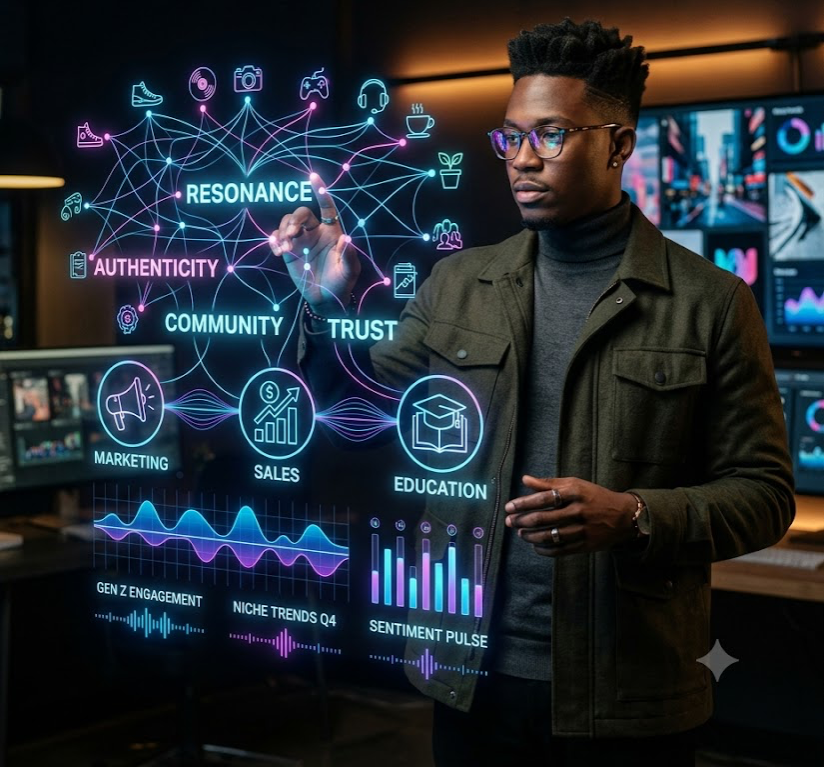
Let’s begin by defining vibe coding. Simply put, it is programming without programming — or, more accurately, AI-assisted programming using natural language. You no longer necessarily need to know how to code, but you do need to understand planning, processes, architecture, creativity, and problem-solving in order to develop your own solutions in the form of agents, chatbots, web pages, software, or internal tools for your company.
This means that those of us who are not programmers can now program using vibe coding. Think about when Canva came out and those of us who were not designers suddenly started designing. Did that mean designers were no longer needed? Of course not. Quite the opposite. Designers are needed more than ever, but now they perform their work differently by using technology to enhance their human talent.
That is my invitation to you: use vibe coding to increase your human potential in marketing and sales.
- From writing code line by line to directing coding agents
In the past, a programmer needed to learn programming languages and write code line by line. Today, many of those tasks can be requested directly from AI. And the rest of us — those who are not programmers — can also begin to do this.
Of course, our results will not be the same as those of a professional programmer who has much more precision, technical knowledge, and experience. But we can move beyond using AI only for prompting and begin developing our own AI-powered solutions.
In this sense, the sky is the limit. Vibe coding allows us to explore new territories in marketing that few people have explored. We have a great opportunity to be among the first, if we are willing to invest the time, effort, and resources required.
- Why it matters for professionals who are not programmers
Vibe coding matters because it allows us to take marketing to the next level. Now you can decide what to create in order to generate value in the life of your consumer through artificial intelligence solutions that you can develop by simply chatting with your preferred AI and then taking those responses into an AI programming tool such as Claude Code or OpenAI Codex.
If you are a marketing professional and you are not using vibe coding, I can tell you that you are falling behind. It is similar to when companies began implementing digital marketing solutions and some people were not sure whether to adopt them. Or, for those of us who have been around longer, it is like when the internet emerged and many people were unsure whether it was worth joining that trend.
What is interesting is that vibe coding represents a new way of working today and in the future: humans interacting with AI to transform creativity into projects that generate value for our clients.
- Examples in marketing, sales, and education
Here are three examples of AI solutions that I have developed using vibe coding. The tools I use include both Claude Code, from Anthropic, and Codex, from OpenAI. In all of these projects, I used a combination of both. Both are easy to use, but each has its own characteristics. To learn more about this topic, I recommend reading our vibe coding course in this issue.
Sales
I developed this agent for my sales class so students can calculate TAM, SAM, and SOM. If the app is asleep, just click on it to wake it up and use it:
https://tam-agent.streamlit.app/
Marketing
I developed this chatbot so my students could improve their personal brand by sharing a real job posting they found online. The AI helps them prepare their elevator pitch, résumé, and LinkedIn “About” section so their personal brand is aligned with the job opportunity and the employer:
https://personal-branding-chatbot.streamlit.app/
Academia
I developed this agent to act as a research assistant and help me identify the most important parts of academic articles within the literature. It also recommends which sections I should read to include in my project, based on my research question, helping me use my time more efficiently:
https://gtaagent-literature-review.streamlit.app/
- Risks: errors, security, privacy, and excessive dependence
Like any technology, vibe coding can involve risks if we do not know what we are doing. Let’s begin with security. If we do not properly build an app with the right safeguards and barriers, our agent or application could be hacked, and confidential client information could be stolen. That is why we need to be especially careful with security and data privacy.
Another risk is that, if your agent or app uses AI APIs, poor configuration can generate high or unnecessary costs. At the end of the day, many agents, chatbots, or apps you develop may use AI from one of the large companies, such as Anthropic or OpenAI. And, in those cases, you have to pay for that service.
I am not referring only to the monthly personal-use plans that many of us have and that I recommend. I am referring to the usage generated by the agent, chatbot, or web app when it performs an AI activity: making a request, searching for information, generating a response, processing a solution, and so on. All of those actions may use AI from a large company, and that usage may have a cost.
There is nothing wrong with paying. It is fair to pay when you are using a service. The problem is when, because of an error or poor programming, your agent spends more resources than necessary.
For more information, check out the vibe coding course.
- Conclusion: the new skill is not only using AI, but building with AI
Vibe coding is here to stay, and every day it will become easier to use. There are already closed systems that offer the ability to create agents and chatbots. These can be good options, but because they are closed systems, their functions are already predetermined, and there is not much you can do to personalize them.
In contrast, if you use more flexible tools to create personalized solutions, such as Claude Code or Codex, you can begin building from the ground up with greater freedom. This gives you more room to develop your agent with fewer limitations and more creativity.
The main limitation will be your own imagination and creativity.
So, I wish you great success in your vibe coding projects.
Author: Dr. Carlos Valdez. Date: May-June 2026.
Editorial assistance: ChatGPT 5.5 — spelling, grammar, and style editing while preserving the author’s voice.
Image generated with: ChatGPT / GPT Image 2.
Publication: Revista Mercadotecnia y Ventas.
© Revista Mercadotecnia y Ventas 2026. All rights reserved. Reproduction without the author’s permission is prohibited.
Editorial syndication: This content is available for syndication. For editorial licensing or collaborations, contact: carlos.valdez@mercadotecniayventas.com.