Article for Academic Researchers
The Knowledge Almost Nobody Applies
The Australian Business Deans Council list includes 174 journals dedicated exclusively to marketing. Each year, therefore, a great deal of scientific knowledge is generated in marketing and sales, but does that knowledge reach the industry? Does it impact the discipline in action?
Even when you review the literature, journal websites tell you how many times a paper has been cited, and the vast majority have never been cited within the same database. This is not just that industry does not read academic research, it is that not even within the academic community itself is all the knowledge produced actually consumed. Industry thus operates on empirical knowledge while academia operates on scientific knowledge.
There are rare and valuable exceptions where the impact of research does permeate industry, but that makes the question valid: for whom do you do research? To fulfill the requirements and merit criteria of your university? To advance the discipline and make it better in practice? To contribute to a better society? Or for all of the above?
There is a very clear and long-standing gap between empirical knowledge and scientific knowledge. In the Journal of Marketing in 2009, Reibstein, Day, and Wind raised an important and relevant question: is marketing academia losing its way? Their analysis highlighted that research had become oriented toward quantitative modeling, moving away from the real challenges faced by marketing executives in the field (Reibstein, Day & Wind, 2009).
This gap does not close through existing structures. Research is evaluated based on where it was published, and the journal with the highest academic rigor gives you more prestige, but not all research necessarily impacts industry. In many cases, this produces a paradox: excellent knowledge generated but not applicable.
According to Nyilasy and Reid (2007), academics and practitioners not only work separately, their conceptual frameworks, questions, and challenges are fundamentally different.
In industry, over my 30 years of professional activity, I have never heard a marketing executive reference an academic paper, but I have heard many reference the Harvard Business Review. It is worth acknowledging that HBR has played an important role in closing that gap by publishing practical extracts from research published in academic journals, but beyond that there is nothing more solid. Many journals now require that publication samples extend beyond students, and that is valid since knowledge should be made more applicable. There are also practice-oriented journals, and that is fine, but none has achieved the positioning that HBR has. This is an opportunity for everyone.
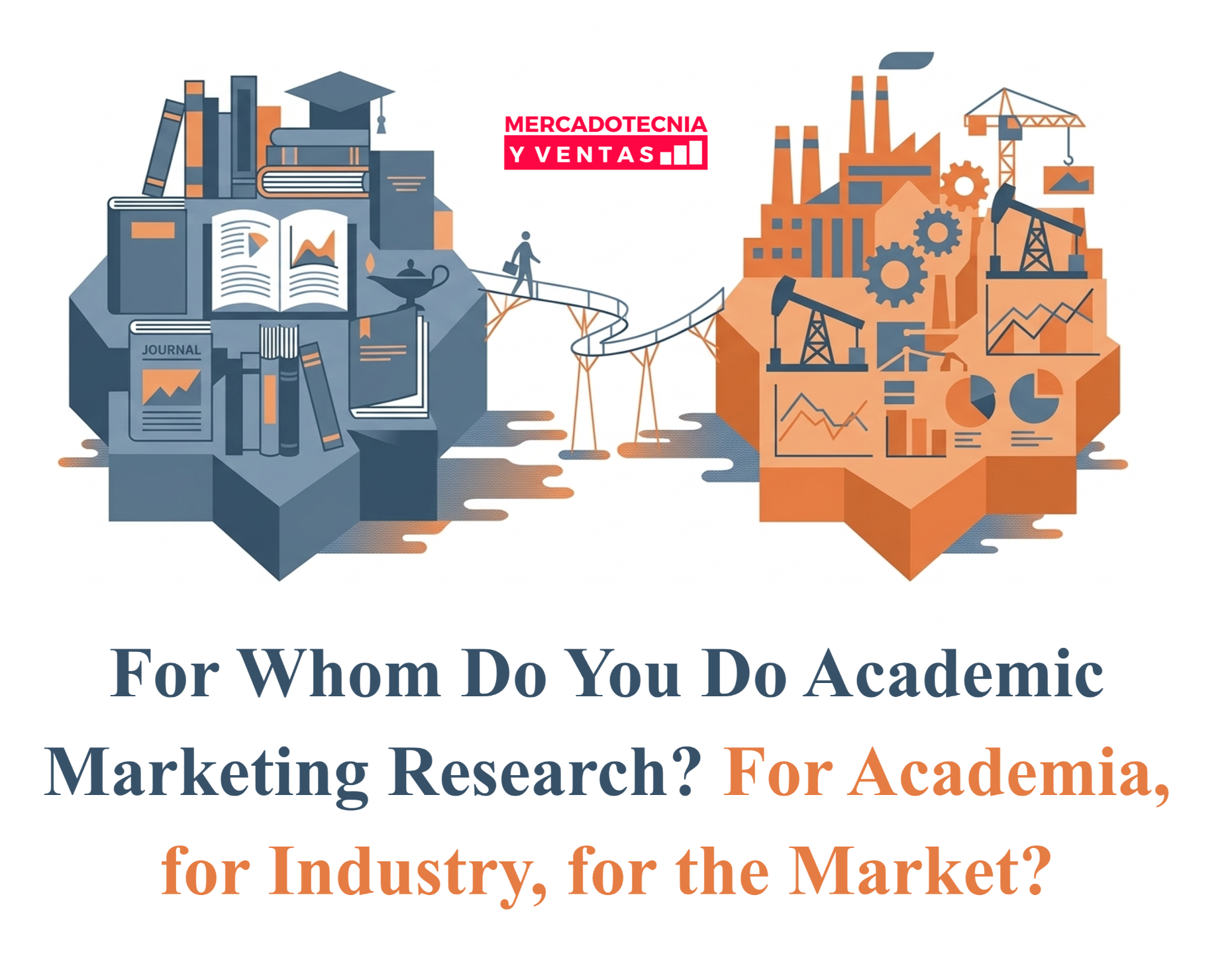
At mercadotecniayventas.com we also want to address this need to bridge the gap between two parallel worlds that operate as multiverses when they should really be operating as one.
How many of the articles you have published have influenced a marketing decision in industry?
Three Reasons Why Academia Can Fall Behind
Marketing academia can fall behind not only because of the gap, but also because of response time, failure to learn and unlearn quickly, the assumption that absolute truth exists in our discipline, and lack of connection with the market and with AI. But all of these are correctable. Let us discuss each one.
First: academia is slow to move and respond to the market.
Today, all of industry has been using AI for years, while academia is still debating how to teach it, use it, or apply it. For example, from the time a professor or researcher conducts a study to the time it is published, years can pass, and by then the market and conditions may have already shifted and the findings may no longer be relevant (Reibstein, Day & Wind, 2009). Academia values the academic quality of research while industry focuses on applicability and solving today's problems. As researchers, we can strive to meet both objectives: rigorous scientific research that is also applied to the real problems industry faces today.
Second: in academia we do not have absolute truth.
Unlike other disciplines where the fundamentals are more stable, in marketing the market changes constantly. We do not have absolute truth, what was true ten years ago may be obsolete today. This means that our responsibility as educators and researchers is to stay connected to industry: starting with our alumni, with their companies, and with industry reports. The more in tune we are with the market, the better our classes, our research, and our impact as educators will be.
Hunt (2002) argued that academia must be a self-critical discipline. Are you in contact with industry? Are you bringing today's real problems into your classroom to prepare your students for the current market?
Third: rejecting AI in research is the most expensive mistake of this generation.
Technology has transformed the research process in every generation. First we read articles in print, then we searched for them on CD-ROM, then in online databases. Today AI can help us conduct literature reviews in hours that once took weeks, with broader coverage, better synthesis, and fewer selection biases. Always use AI ethically and responsibly, but use it. Industry uses it. Why not use it in academia, across all our areas of work, including research? Always following the principle of trust but verify.
How do you use AI in your research?
The Research the Market Needs
Rigor and relevance are not opposites, and the classics of the discipline demonstrate this. Here are some examples of how scientific research has affected industry. Levitt's (1960/2004) marketing myopia helped marketers understand how to generate value and for whom. Keller's (2003) brand equity model became the global standard for how to manage brands. The American Customer Satisfaction Index by Fornell et al. (1996) is today a national economic indicator that measures consumer satisfaction across more than 400 companies and 40 industries, used by businesses, investors, and governments as a performance benchmark. The research of Reichheld and Sasser (1990) published in HBR is the intellectual origin of the Net Promoter Score, today the most widely used loyalty indicator in industry worldwide. And Rogers' (1962) adoption curve became the universal language through which all of industry understands product launches and the diffusion of innovation. These are examples of research that combined academic rigor with real-world impact and represent the standard to which the discipline can aspire.
Reibstein, Day, and Wind (2009) said it in the Journal of Marketing: we need to produce quality research that is also relevant, research that speaks to decision-makers, not only to those who publish.
For Madhavaram (2024), the most impactful research is that which addresses broad strategic topics, has strong theoretical content, and is programmatic, not research that answers microscopic questions for minimal audiences. Programmatic research accumulates. Isolated research disappears.
Does your next research project contribute to science and to the application of that science in today's market?
AI Is Already in the Lab. Is It in Yours?
In research we have always adopted technology to improve. So why not now with AI? It is the most powerful tool we have, and I do not understand the resistance to it in academic research in some sectors. AI does not replace the researcher, it amplifies our work.
The evolution of the research process across three generations: print, CD-ROM, online databases. Each technological leap multiplied the researcher's capacity. AI is the fourth leap and the largest. There are tools available today that transform every stage of the process: literature discovery (Semantic Scholar, Elicit, Consensus), mapping connections across studies (Litmaps, Connected Papers, Research Rabbit), comprehension of complex papers (Explainpaper, Scholarcy), reference management (Zotero), data analysis (Julius AI), academic writing (Writefull, Paperpal, Trinka), and integrated platforms such as SciSpace and NotebookLM (Valdez, 2026, February).
For systematic literature reviews, we developed a specific agent trained for the complete process: GTA Agent, available at https://gtaagent-literature-review.streamlit.app/, a tool that allows you to accelerate literature reviews without sacrificing rigor (GTA Agent, 2026).
The responsible use note is key: these tools support academic judgment and do not replace it. Intellectual authorship remains with the researcher.
Transfer your contributions to the market, to companies, to your students, impacting the groups you serve as an educator and researcher.
References
Fornell, C., Johnson, M. D., Anderson, E. W., Cha, J., & Bryant, B. E. (1996). The American Customer Satisfaction Index: Nature, purpose, and findings. Journal of Marketing, 60(3), 7-18. https://doi.org/10.1177/002224299606000403
GTA Agent. (2026). AI-powered literature review agent. https://gtaagent-literature-review.streamlit.app/
Hunt, S. D. (2002). Foundations of marketing theory: Toward a general theory of marketing. M.E. Sharpe.
Keller, K. L. (2003). Strategic brand management (2nd ed.). Prentice Hall.
Levitt, T. (2004). Marketing myopia. Harvard Business Review, 82(7/8), 138-149. (Original work published 1960)
Madhavaram, S. (2024). Chartering marketing strategy and marketing management research toward greater relevance and impact. Journal of Business Research, 172. https://doi.org/10.1016/j.jbusres.2024.114380
Nyilasy, G., & Reid, L. N. (2007). The academician-practitioner gap in advertising. International Journal of Advertising, 26(4), 425-445. https://doi.org/10.1080/02650487.2007.11073030
Reichheld, F. F., & Sasser, W. E. (1990). Zero defections: Quality comes to services. Harvard Business Review, 68(5), 105-111.
Reibstein, D. J., Day, G., & Wind, J. (2009). Is marketing academia losing its way? Journal of Marketing, 73(4), 1-3. https://doi.org/10.1509/jmkg.73.4.001
Rogers, E. M. (1962). Diffusion of innovations. Free Press.
Technical Card
Author: Dr. Carlos Valdez. Date: March 2026. Editorial assistance: Claude Sonnet 4.6, proofreading, grammar correction, research, and academic reference verification. Image generated with: Gemini 3 Nano Banana. Publication: Revista Mercadotecnia y Ventas. All rights reserved, Revista Mercadotecnia y Ventas 2026. Reproduction without the author's permission is prohibited. Editorial syndication: This content is available for syndication. For licensing or editorial collaborations, contact: carlos.valdez@mercadotecniayventas.com